BBR · Diagnosis and compatibility check
Bike bottom bracket replacement—prove the job before buying the tool
A creak can travel through the frame. A 16-notch cup can have several diameters. A press-fit bearing needs more than a remover. Build the identity record first, then open only the procedure and tools that fit the real system.
A focused decision path for this exact job. Verify fit and safety details against the current maker instructions.

Interactive utility
Build a Bottom Bracket Job check
Four records decide whether to isolate a symptom, service an adjustment, identify the shell, open a model-specific procedure, or hand the press-fit job to a shop. The check never guesses thread direction, torque, drifts, spacers, or an exact replacement.
Check incomplete
Answer all four records
The result will separate replacement evidence from compatibility and tool readiness, and highlighting any information still needed.
Why the check exists
Park Tool’s own fitting table defeats the idea of one universal “16-notch” tool.
Count the fitting—then measure it
These examples are a warning against appearance-based shopping, not a complete selector. Proprietary styles and model-specific exceptions still exist.
| Fitting | Dimension | Park Tool examples | Boundary |
|---|---|---|---|
| 20 internal splines | 31.5 mm ID | BBT-22 / BBT-32 | Common cartridge fitting; the exact model still controls compatibility. |
| 16 external notches | 39–40 mm OD | BBT-49.3 / BBT-29 | Not interchangeable with a larger 16-notch cup. |
| 16 external notches | 41–42 mm OD | BBT-59.3 | The notch count alone does not select this tool. |
| 16 external notches | 44–45 mm OD | BBT-69.4 / BBT-19.2 / BBT-9 | Used by select external-cup families; verify the model and dimensions. |
| 16 external notches | 52–54 mm OD | BBT-47-16 | A visibly similar but materially larger fitting. |
| 24 external notches | 45–47 mm OD | BBT-79.3 / BBT-179 | Includes listed SRAM DUB examples—not a 16-notch path. |
Job sequence
These six checks apply across systems. The standard, procedure, parts, directions, torque and tooling are not.
Six checks before replacing a bottom bracket
- 01
Prove the job
Isolate bearing roughness, binding or another maker-defined failure. Noise-only suspicion routes to diagnosis; crank-side play first routes through the exact fastening and preload inspection.
- 02
Identify the architecture
Record threaded, press-fit, thread-together, adjustable cup-and-cone, one-piece or another documented system. Do not infer it from bicycle age or a distant photo.
- 03
Lock the frame record
Find the exact frame model/year, shell standard, width, diameter, threads and maker restrictions. Measurements support the record but do not replace it.
- 04
Lock the crank record
Find the exact crank and spindle family, interface, diameter, spacing, chainline, preload and removal method. The old part can be evidence, not the complete compatibility chart.
- 05
Select the official procedure
Only now open the correct removal direction, preparation, spacers, torque, drift or service sequence. Keep threaded, press-fit, thread-together and adjustable procedures separate.
- 06
Inspect and test conservatively
Check crank retention, preload, binding, play, seal and frame condition by the maker procedure before any controlled test. Stop on structural damage, movement in the shell or unresolved play.
Stop conditions
Do not turn a near-fit or unexplained creak into frame damage
- The frame, shell, crank, spindle, bearing seat or threads are cracked, distorted, corroded, impact-damaged or moving in the frame.
- Play may come from a loose crank, missing or incorrect preload, damaged spindle or another interface rather than a failed bearing.
- The shell standard, thread direction, tool fitting, crank interface, spacer stack or replacement compatibility cannot be established.
- A press-fit part would be struck or pressed without the exact supported remover, drifts, press, alignment and frame-protection procedure.
- A removed pressed bearing or cup would be reused without explicit maker permission and inspection criteria.
- A replacement “almost fits,” needs improvised force, changes chainline unexpectedly, binds, or leaves play after the specified preload process.
- An e-bike motor, torque-sensing bottom bracket, wiring or proprietary lockring falls outside the exact documented service path.
- Crank retention, bearing movement, binding, structural damage or unexplained noise remains after assembly. Do not convert that uncertainty into a road test.
Products and tools
Tools are specification options only after their interfaces are proven.
The wrong tool does not appear
For supported 20-spline fittings
Park Tool BBT-22
$26.95 observed at Jenson USA
Only for a listed 20-spline, approximately 31.5–32 mm fitting such as supported square-taper, Octalink or ISIS-family cartridge models. Not designed for impact tools.
Select 16-notch cups
Park Tool BBT-9
$38.95 observed at Jenson USA
Only after the external-cup model and correct 16-notch diameter are confirmed. Park Tool lists several materially different 16-notch diameters; the notch count by itself is not a fit check.
22/24 mm press-fit option
Park Tool BBT-90.3 set
$62.95 observed at Jenson USA
For most press-fit bearing units using a 22 or 24 mm spindle, including BB90/BB92. Installation also needs HHP-2/HHP-3 or another explicitly compatible press; it is not a universal press-fit kit.
For supported three-piece cranks
Park Tool CWP-7 crank puller
$17.95 observed at Jenson USA
For cranks with M22 x 1.0 extractor threads and a supported square-taper, PowerSpline, Octalink or ISIS interface using the correct rotating foot. Nonstandard extractor threads are excluded.
Check exact fit
Replacement bottom bracket
No universal replacement selected
Requires the exact shell, width, diameter/threads, crank and spindle interface, spacing/chainline, maker compatibility, installation procedure and current store listing.
Press system / shop decision
Bearing press and drifts
Do not assemble from price alone
The bearing or cup, shell and frame procedure must explicitly support the press, drift faces and extraction method.
How to verify
Bottom bracket manuals and tool specifications
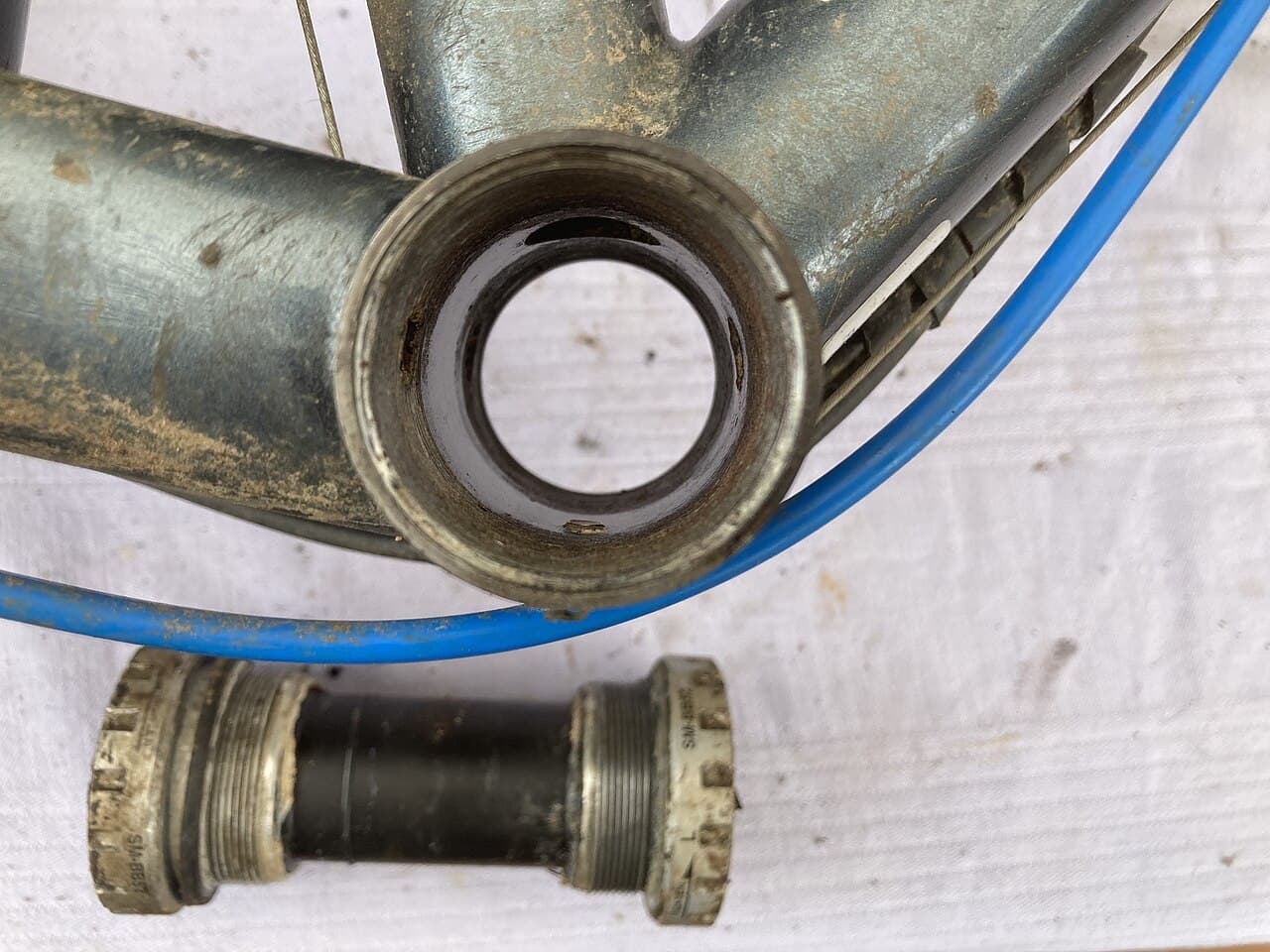
This practical decision guide organizes current technical instructions into a conservative decision path. The site did not diagnose the pictured bicycle, remove or press a bearing, torque a cup, compare tools, verify noise reduction, or install a replacement.
- Park Tool: bottom-bracket identification and threaded tool selection.
- Park Tool: press-fit removal and installation and press-fit tool selection.
- Park Tool: troubleshooting a noisy drivetrain — a frame can transmit sound from another interface.
- BBT-22 official fitment, BBT-90.3 instructions, and CWP-7 compatibility.