BBR · Wear and compatibility check
How to replace a bike chain—without guessing the chain
A chain can be worn, damaged, merely noisy, or innocent of the symptom. Measure with a compatible method, identify the drivetrain family, then show the correct chain, connector, sizing method and tools.
A focused decision path for this exact job. Verify fit and safety details against the current maker instructions.

Chain replacement checks
Build a Chain Replacement check
Four records decide whether to measure, diagnose, replace, or stop. The tool deliberately does not calculate a universal link count or recommend a chain from speed count alone.
Check incomplete
Answer all four questions
Your result will separate wear evidence from installation readiness and show what still needs checking.
Replacement sequence
The order is reusable. The threshold, chain, connector, link count and tools are not.
Six gates between “old chain” and a safe test
- 01
Prove the need
Measure normal wear with a checker or dimensional method that supports the exact chain and use the chain or drivetrain maker’s threshold. Mileage, noise and a skip are prompts to inspect—not replacement measurements.
- 02
Record compatibility
Capture chain maker/model or published replacement family, drivetrain family, speed/system, direction, e-bike constraints, cassette and rear-derailleur compatibility, and the specified connector.
- 03
Open the sizing method
Use the exact current-chain method, big-to-big method, chainstay table, setup-cog method, or another procedure published for the real system. Do not mix steps from different drivetrains.
- 04
Remove at the permitted place
Power an e-bike down or enter service mode when required. Release a supported quick link or drive a rivet only where the chain instructions permit; protect the derailleur and do not reuse a one-time connector.
- 05
Size, route, and connect
Confirm derailleur-pulley routing, chain direction, link count, connector orientation, required tool, pin depth or peening process, and complete activation of the quick link or pin.
- 06
Inspect before loading
Rotate the crank by hand, watch every link and pulley, check all gears without standing load, then perform only the maker’s controlled test sequence. Stop if the new chain binds, drops, skips or loses drive.
Maker controls
Do not average these rules into one universal threshold or sizing recipe.
Four brand labels still contain different chain systems
| Family | Wear decision | Replacement boundary |
|---|---|---|
| Shimano ↗ | Exact chain record and supported wear-indicator path; service guidance identifies TL-CN42. | Match the exact chain and connection method. The cited 12-speed manual requires a new QUICK-LINK with a replacement chain. |
| SRAM Road / Eagle ↗ | Approved checker list and 0.8% elongation threshold. | Road Flattop, Eagle and T-Type follow different compatibility and sizing paths. Match the chain to cassette and derailleur family. |
| Campagnolo 11/12/13s ↗ | For the cited chains, measure the specified six-outer-link span at multiple places; 132.60 mm is the model-manual maximum. | Exact speed, direction, C-Link or pin, sizing procedure and prescribed tool/process control. |
| KMC ↗ | Its current checker says that a reading exceeding 0.8 indicates replacement. | Confirm the exact chain/system compatibility, length and MissingLink model instead of treating “KMC” as one universal chain. |
“How long does a chain last?” has no honest universal mileage answer. Park Tool, Shimano and Campagnolo all tie life to conditions and maintenance; the measurement and model record decide.
Stop conditions
Do not turn a damaged drive chain into a road test
- A plate is cracked, twisted or severely corroded; a pin is displaced; or the connector is damaged, loose, reused against instructions or unknown.
- The chain jams, breaks, enters the spokes, frame, motor or guard, or loses drive. Inspect surrounding components before installing another chain.
- The chain/drivetrain family, compatible checker, threshold, replacement record, direction or connector cannot be established.
- Sizing would rely on a generic link count, an old chain whose length was not confirmed, or a procedure from another drivetrain family.
- The required chain tool, connector tool or Campagnolo/other peening process is unavailable or unsupported.
- An e-bike cannot be powered down or put into the instructed service state before work.
- The new chain binds, drops or skips after installation. Do not reproduce the fault with standing load, motor power or road speed.
- The drivetrain has impact damage, a bent hanger, damaged sprockets, a failed freehub/freewheel or another unresolved loss-of-drive cause.
Products and tools
Match each tool to the confirmed job and chain. This site has not tested these tools, and no chain fits every drivetrain.
Tools appear only after their job is proven
Most conventional chains
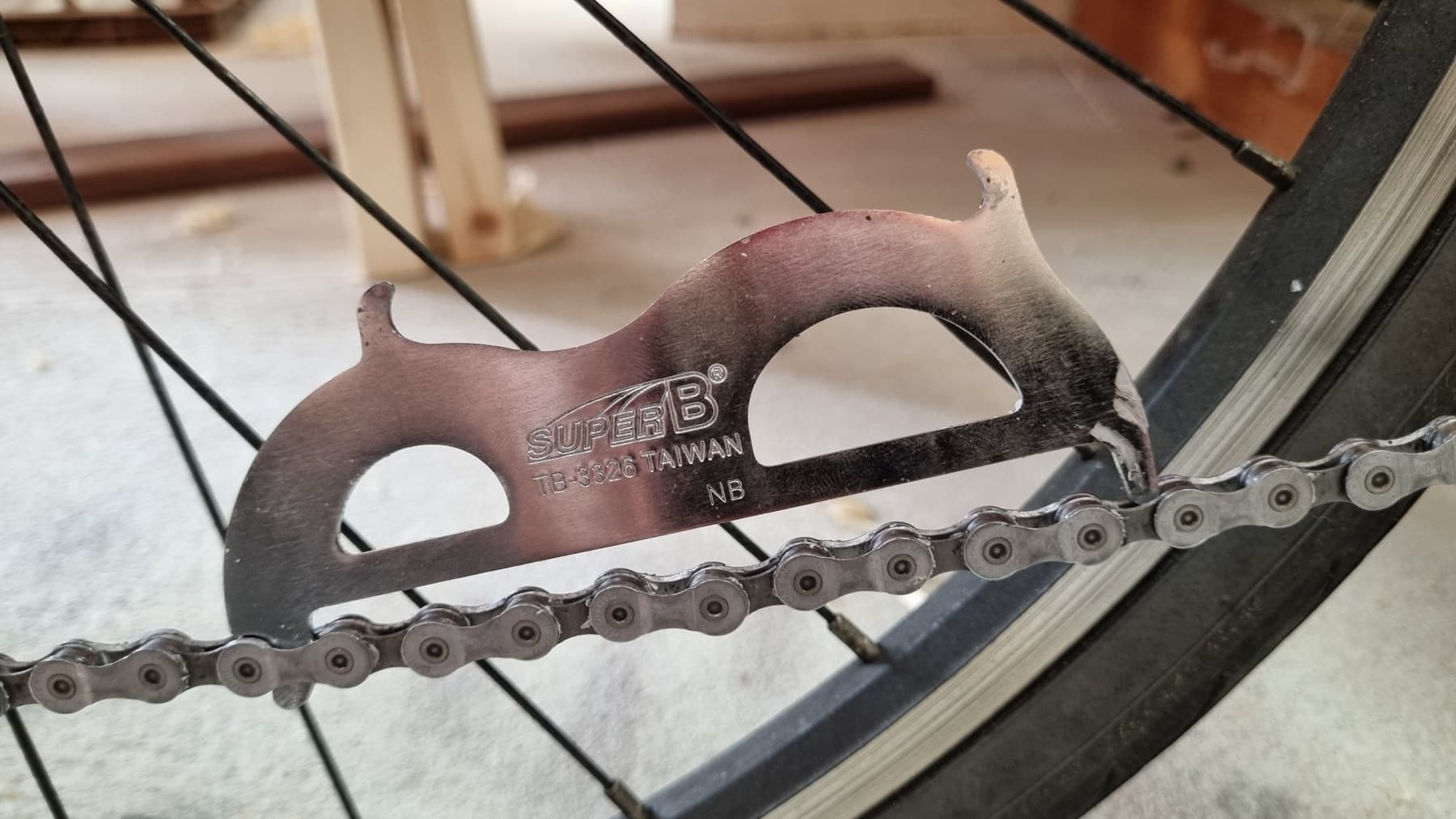
Park Tool CC-2 chain checker
$27.95 observed at Jenson USA
Most single-speed and derailleur chains; explicitly not SRAM Flattop or T-Type. Read it using its instructions, then apply the exact chain maker’s threshold.
SRAM-specific option
SRAM Chain Wear Indicator
$40 observed at Jenson USA
SRAM model TL-CNTL-WEAR-A1. SRAM states that it supports existing SRAM chain models and uses the 0.8% critical specification. It does not choose the replacement chain.
Connector-qualified
Park Tool MLP-1.2 master-link pliers
$18.95 observed at Jenson USA
Only after a supported two-piece master link is confirmed and the chain maker’s opening, closing and reuse rule is known. Clip-style and model-specific links stay separate.
Cutting-qualified
Park Tool CT-3.3 chain tool
$48.95 observed at Jenson USA
Only after chain support, cutting location, link count, connector and any peening process are known. Campagnolo and other model-specific procedures may require different or additional tools.
Check exact fit
Replacement chain
No universal chain selected
Requires drivetrain and chain family, speed/system, current compatibility chart, direction, length source, connector, e-bike constraints and an authorized seller record.
Find the cause first
Cassette, freewheel, or chainring
Do not bundle with a chain by default
A new-chain skip must first isolate sizing, connection, routing, indexing, hanger, sprocket wear and hub engagement; then the exact rear-cluster compatibility check still applies.
How to verify
About this guide
This practical decision guide converts current maker and tool instructions into a conservative decision path. The site did not measure the pictured chain, replace a chain, activate a connector, compare tools, record service life, or reproduce a skip.
- Park Tool: when to replace a worn chain and CC-4.2 compatibility.
- SRAM approved chain-tool map and SRAM Chain Wear Indicator.
- Shimano chain dealer manual — model-specific chain, QUICK-LINK, direction, tool and replacement controls.
- Campagnolo 12-speed chain manual — exact dimensional wear and connection procedure for the covered chain.