BBR · Tire fit guide
Bike tire size chart: find the size that actually fits
Ignore “26,” “28,” “29,” and even “700C” until you find the millimetre code. Match the bead-seat diameter first; then prove width, tire system, bicycle clearance, and pressure.
Read the code, not the nickname
40
Nominal tire width
622
Exact bead-seat diameter
Tire 40-622 + rim 19-622
The shared 622 clears only the diameter gate. The 40 mm tire still needs maker approval for the 19 mm inner rim, the exact rim profile, the bike, and the permitted pressure.
The first number on a rim code is normally its internal width; it is not supposed to match the tire’s first number.
The useful chart
Legacy names help you search. Only the printed bead-seat diameter confirms the size family.
Common names translated into bead-seat diameter
| Common label | Likely BSD, mm | Why the label is not enough |
|---|---|---|
| 700C road / gravel | 622 | Often shares diameter with 29-inch MTB; width and bike clearance still differ. |
| 29-inch MTB | 622 | Same common BSD as 700C, not proof that every 29er tire fits a road or gravel rim. |
| 27.5-inch / 650B | 584 | A useful alias only after the printed 584 code is confirmed. |
| Common modern 26-inch MTB | 559 | “26-inch” can also describe incompatible 571, 590, or 597 mm tires. |
| Traditional 27-inch road | 630 | Not interchangeable with 622 mm 700C despite the similar name. |
| 20-inch | 406 or 451 | Two common, incompatible bead-seat diameters share the same inch label. |
| 28-inch | Usually 622; sometimes 635 | The inch label alone is not a buying specification. |
These are translation clues, not a universal compatibility table. Confirm the code on the old tire, the rim or wheel manual, and the replacement tire.

Width is a system
A “40 mm” tire may not mount 40 mm wide
The sidewall number is nominal. Actual width and height can change with the tire model, casing, inflation pressure, and rim inner width. A wheel may accept the beads while the inflated tire still rubs the frame, fork, brake, or fender.
Use the current chart from the exact rim or tire maker. Record the installed measurement at a permitted pressure and check every required clearance. A generic tire-to-rim ratio is a screening clue—not an approval.
Do not assume “wider is better.” Tire size also changes handling, casing shape, bottom-out risk, fender space, toe overlap, and sometimes brake compatibility.
Five gates
One matching number is the start, not the verdict
- 01
Diameter
The second tire and rim ETRTO numbers match exactly.
- 02
Width
The current tire/rim maker chart approves the tire width for the rim’s measured inner width.
- 03
System
Tube-type, tubeless-ready, hooked, and hookless markings form an approved combination.
- 04
Bicycle
The installed tire clears frame, fork, brakes, fenders, and moving parts as the bike maker requires.
- 05
Pressure
The lowest maximum across tire, rim, tape, tube/insert, and bike is recorded and respected.
Hookless branch
Hookless fit is an exact-model question
Do not apply a generic chart to a straight-side or hookless rim. Verify the rim maker’s approved tire list, size, inner-width range, tire-system marking, and maximum pressure—then cross-check the tire maker. Respect the lower limit when the numbers differ.
Tube does not override it
Some hookless systems require a tubeless-ready tire even when an inner tube is installed.
Diameter is not approval
Matching 622 codes cannot prove bead retention or pressure compatibility.
Unknown means stop
Do not test an uncertain hookless fit by seating it with higher pressure.
Before buying
What to confirm before buying tire parts
Replacement tire
Tire code, rim code, system/profile, current width approval, load/use, bike clearance, pressure limits
Inner tube
BSD, tube range covering the actual tire width, tube material, valve type and length, rim valve hole, pressure/use
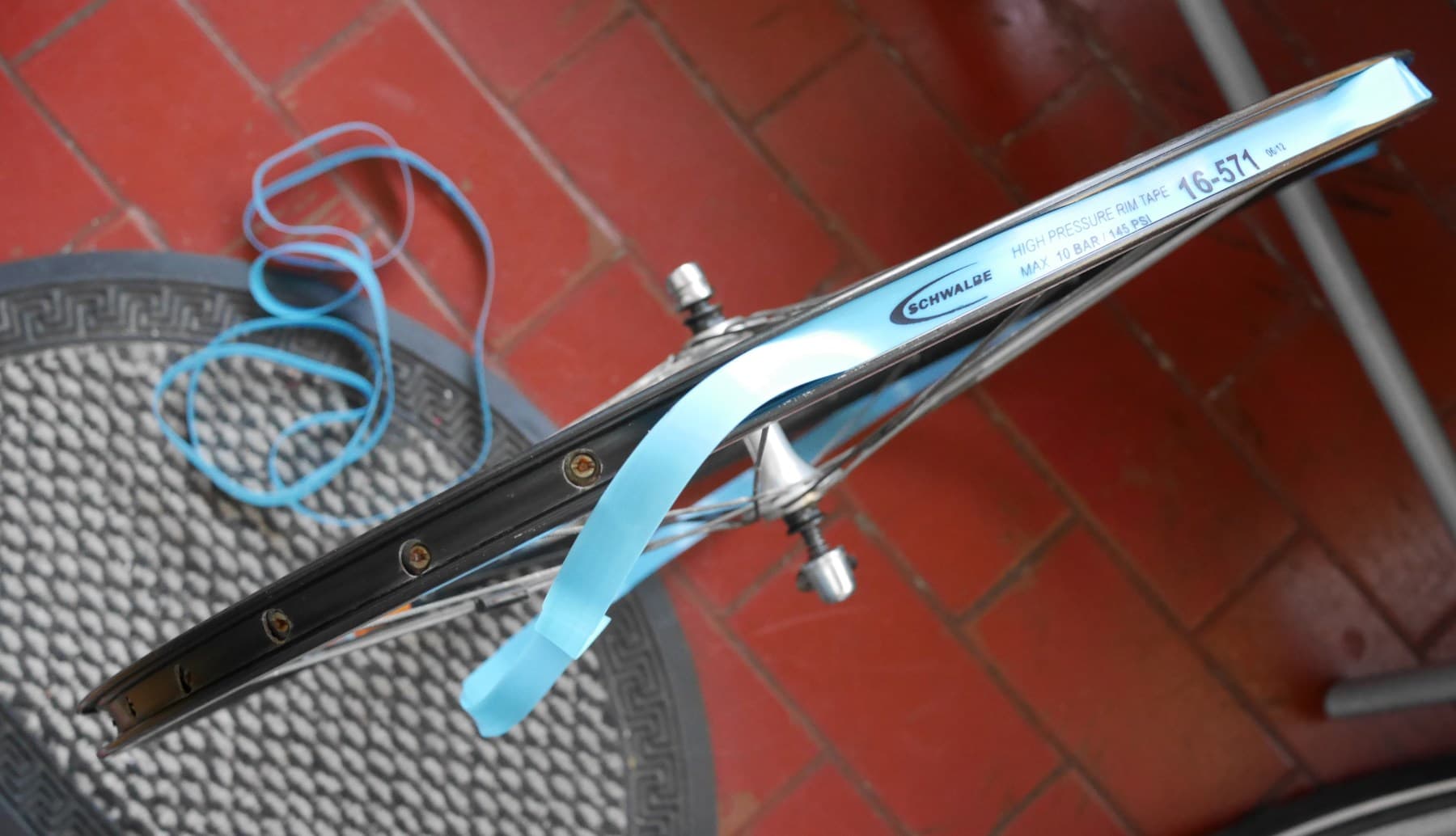
Rim tape
Measured inner width and rim bed, spoke-hole coverage, tube/tubeless system, required layers/material, pressure rating
Pump or gauge
Valve interface, working pressure range, gauge readability, tire volume, portability and head clearance
If any field is unknown, pause. Check the exact tire, rim, wheel, and bicycle instructions—or ask a bike shop to confirm the fit before ordering.
Technical references
Use the exact component instructions when they are stricter
- Michelin bicycle tire sizes — how the ETRTO width and bead-seat diameter code relates to legacy labels.
- Schwalbe tire sizes — why inch labels can describe several incompatible inner diameters.
- Park Tool fit standards — tire/rim BSD, rim internal width, inner-tube range, valve, and bicycle-clearance checks.
- Schwalbe / ETRTO tire-rim combinations — maker-published inner-rim-width combinations and straight-side-rim boundary.
- Continental hookless guidance and ENVE approved-tire guidance — examples of model-specific tire lists and pressure limits.
This guide cannot inspect markings, measure mounted dimensions, discover hidden rim or tire damage, or replace the bicycle, wheel, rim, tire, tube, tape, valve, or pressure instructions.